
Affordability crisis spurs demand for fair raise from South Florida health care workers

The affordability crisis is hitting Florida’s most populous county — Miami-Dade —hard. Working people in the South Florida county are cutting back on purchases, taking second jobs, even choosing between paying skyrocketing electric bills and escalating home insurance bills.
That’s why members of AFSCME Local 1363 joined their co-workers at SEIU Local 1991 and the Committee of Interns and Residents/SEIU for a rally this month to call for a 4% cost-of-living adjustment (COLA) in their new contract.
Local 1363’s members are hardworking health care workers who keep the county’s major health care provider, Jackson Health System (JHS), running. They deserve a COLA that will help them afford to live in the expensive greater Miami region.
“We are not asking for more than we deserve. We are not asking for something that is out of line with other county workers, and we are not going to accept getting less than what they are getting in their paychecks,” said William Orange, a nutrition worker and president of Local 1363, referring to other county workers.
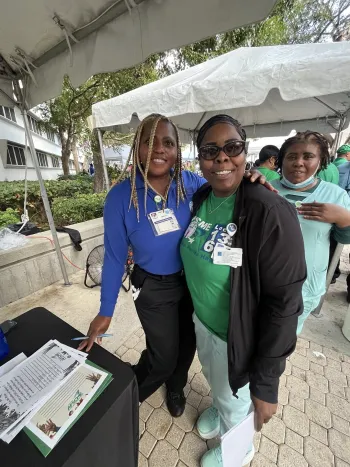
Jackson Health System is a nonprofit medical system governed in part by the Miami-Dade Board of County Commissioners. Local 1363 members, who work for JHS, argue they should get the same COLA that other county workers received.
Instead, JHS initially offered a 1% COLA with a 2% one-time bonus for Local 1363 members, who argue that it would do little to combat rising costs over time. The local rejected the offer.
Thanks to the pressure members have been putting, JHS has budged a little, proposing a 2% COLA and 1% one-time bonus at the last session. Members of Local 1363 and the two SEIU locals have rejected this as well, focusing on lasting pay increases through a 4% COLA.
“We know this is not about money, this is about the will to do the right thing,” said Orange. “When you can afford to give your CEO a 21% pay bump, which is $242,054 in just his base salary, you can afford a 4% COLA. When you want to balance your budget on the backs of workers making $60,000 a year, your priorities are wrong.”
Orange said the workers are considering declaring an impasse in negotiations. That’s never happened before, but the bargaining teams are united in doing whatever it takes to secure the contract they feel members have earned.